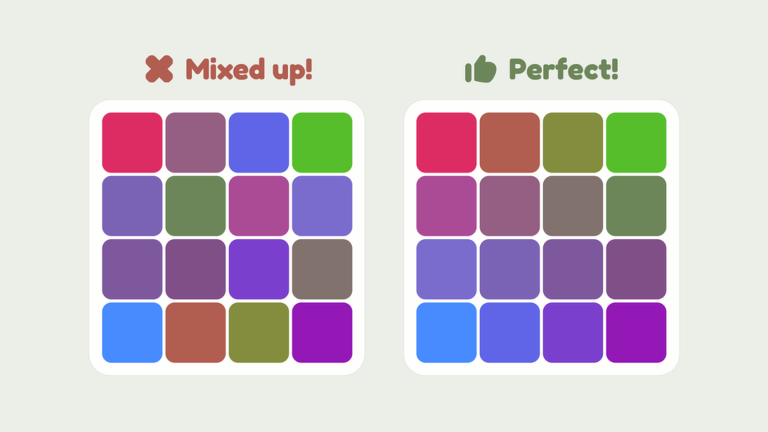
Between Colors is more than swapping tiles to make a gradient. Whether you are grinding Daily Puzzles, racing the clock in Speed Run, or battling in Duels, the difference between a good player and a top player comes down to move efficiency and spatial planning. This August 2026 guide breaks down the advanced strategies that separate casual players from veterans, with a special focus on the center-out method and the hidden mechanics that shave seconds off your best times.
The Strongest Advanced Strategy: Center-Out
The center-out method starts from the middle of the board instead of the edges. Identify the midpoint color of the gradient, which is a blend of the two endpoint colors, then build a small 2x2 patch of that color in the center. From there, expand outward by swapping tiles to extend the gradient in every direction. This approach consistently produces the lowest move count, making it the best choice for Duels where move efficiency matters more than raw speed. It also works well on radial gradient boards and on medium sizes like 6x6 and 7x7. In Daily Puzzles, you have unlimited time to practice this method, so use those boards to train your eye for midpoint colors.
Why Center-Out Wins Duels
In Duels, you are not just racing the clock. Your final score depends on how many moves you make relative to your opponent. The center-out method reduces unnecessary swaps because you are building a coherent patch that grows outward. Each swap moves a tile closer to its final position, rather than shuffling colors around the edges. Veterans also recheck the corner colors after their first few swaps, because the board can become visually confusing when the gradient starts to form. This habit prevents you from accidentally chasing the wrong endpoint.
How to Practice Center-Out Effectively
Use Daily Puzzles to drill the center-out method. At the start, study all four corner colors and determine the two most distinct endpoint colors. Mix them mentally to find the midpoint shade, then locate tiles of that shade near the board center. Create a 2x2 block, then work outward ring by ring, matching each ring to the next gradient step. On a 5x5 board, this can be done in under 20 moves if you plan ahead. On an 8x8 board, the same logic applies but you need to be more patient with ring expansion.
Efficient Setups: Board-Specific Routes
While center-out is the most versatile, you should adapt your setup to the board size and timer. For small boards (4x4 or 5x5) in Speed Run with under 30 seconds on the clock, the corner-first rush is faster. Establish the two endpoint colors immediately by studying the corners, then swap aggressively to push colors outward. For larger boards (8x8) in Daily Puzzles, row-by-row sweeping is easier to track because each completed row acts as a guide. Combine row-by-row with color clustering: group similar colors together first, then do the final fine-tuning. This reduces the total number of swaps.
Hidden Mechanics That Give You an Edge
- Corner Color Analysis: Spend the first three seconds studying all four corners before touching any tile. The two most different colors are the gradient endpoints. Visualize the diagonal or straight path between them.
- Timer Stalling: If you need a moment to think in a timed round, tap any tile without swapping. This pauses the timer for a fraction of a second, giving you breathing room without losing your flow. Use this sparingly, because too many taps can break your rhythm.
- High-Impact Swaps: In Speed Run, do not waste time fixing a tile that is one position off. Focus on swaps that correct multiple tiles at once. Swapping a tile that is three spaces away can fix several mistakes in that row or column.
- Duel Observation: Watch your opponent's board during a Duel. If they make a mistake, you can adjust your own plan to finish with fewer moves. Even if you are slower in wall-clock time, a lower move count can earn you extra leaderboard points.
- Practice Board Repetition: Daily Puzzles are infinite and free to retry. Use them to memorize common color gradients (red-to-blue, yellow-to-green, purple-to-orange). The faster you recognize these patterns, the quicker your first swap happens under pressure.
Practical Strategy Examples
Speed Run on a 5x5 Board
With 25 seconds on the timer, you do not have time for perfect planning. Focus on corner-first. Identify the endpoints, then make a few aggressive swaps to place the correct colors in the corners. Do not stop to fix small imperfections. Aim to complete the gradient in 30 moves or fewer. A top player can finish a 5x5 Speed Run in roughly 15 seconds using this aggressive style, relying on pattern recognition from Daily Puzzle reps.
Daily Puzzle on an 8x8 Board
For large Daily Puzzles, switch to row-by-row sweeping. Start with the top row and work downward, but keep the center-out concept in mind. If you notice a cluster of colors near the center, build from that midpoint outward first, then return to the edges. On an 8x8, the difference between a 140-move solve and an 80-move solve is entirely about whether you group colors before fine-tuning. Use the unlimited timer to test both routes and compare your move counts.
Duel on a 7x7 Board
In Duels, the board size is often 7x7 or 6x6. Use center-out as your default. In the first 3 seconds, identify the endpoints and midpoint. Then make your first 2x2 block in the center. As you expand, keep an eye on the opponent's progress. If they are rushing, you may need to balance speed with move efficiency. Remember that the Duel score rewards lower move counts, not just faster completion, so a controlled center-out expansion usually beats a frantic corner-first rush.
Frequently Asked Questions
Q: What is the center-out method in Between Colors?
A: The center-out method is a solving strategy where you build a 2x2 patch of the gradient's midpoint color in the center of the board, then expand outward ring by ring. This reduces total moves compared to edge-start methods and is especially effective in Duels and on radial gradient boards.
Q: How can I get better at Speed Run in Between Colors?
A: Practice corner-first rushing on small boards, but also train your pattern recognition by repeating Daily Puzzles. Learn common gradients like red-to-blue and yellow-to-green so you can identify endpoints instantly. Use timer stalling sparingly and prioritize high-impact swaps that fix multiple tiles at once.
Q: Does the board size change my strategy in Between Colors?
A: Yes. On 4x4 or 5x5 boards, corner-first rush is faster. On 6x6, 7x7, and 8x8 boards, center-out or row-by-row sweeping with color clustering is more efficient. Medium boards like 7x7 are where the center-out method really shines in Duels.
Conclusion
Between Colors rewards players who think in gradients, not just individual tiles. By mastering the center-out method, adapting your setup to board size, and using hidden mechanics like corner color analysis and timer stalling, you can cut your move count dramatically. Whether you are chasing Daily Puzzle perfection, Speed Run records, or Duel leaderboard points, these advanced strategies will put you ahead of the pack. Start with the center-out method today, and watch your stats improve before the end of August 2026.
Active Between Colors Codes (September 2026)
No verified active codes are available right now for Between Colors.