Choose Your Path to Token Dominance
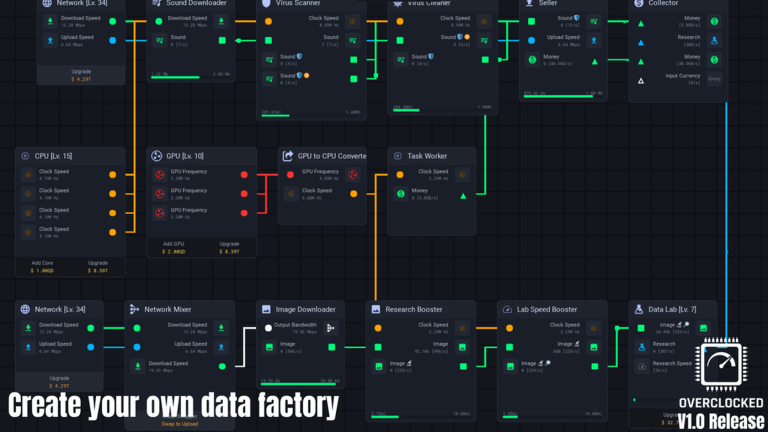
In OVERCLOCKED, your build determines how fast you earn tokens and scale your empire. Whether you are just starting or pushing into the late game, selecting the right layout of nodes can multiply your income tenfold. Based on the latest strategies from top players and community guides, we break down three powerful build archetypes: the Early Token Rush, the Parallel Network, and the GPU Scaling Build. Each has distinct strengths and ideal timing.
Build 1: Early Token Rush
This build is designed for the first hour of play. Begin by placing a single Task Worker (CPU) node and connect it directly to a Token Generator. This gives you a steady trickle of tokens to purchase your first upgrades. Immediately add a Virus Scanner and Virus Cleaner in series after the CPU. Viruses can corrupt your files and cause token loss, so cleaning them early is crucial. Next, insert an Image Downloader and then a Sound Downloader before the Token Generator. These downloaders produce higher-value files, increasing your token output per cycle. Use a Splitter to split the output of your CPU into two parallel lines: one for scanning/cleaning and one for downloading. This prevents bottlenecks and keeps your token flow smooth. Invest your first research points into the Research Booster to unlock faster upgrades. This build works best until you have around 100 tokens per second, then you should transition.
Build 2: Parallel Network
Once you have a stable first network, it is time to build a second, identical network and connect them with a Network Mixer. The Parallel Network build focuses on doubling your throughput without complex wiring. Construct two separate processing lines, each with its own CPU, Virus Scanner, Cleaner, and a mix of Image and Sound Downloaders. Route the outputs of both lines into the Network Mixer, which combines them into a single, higher-volume stream. Then send that combined stream into a single high-capacity Token Generator. This build dramatically increases token output because you are processing two independent data streams simultaneously. It is ideal for the mid-game when you have enough tokens to afford a second CPU but not yet the expensive GPU upgrades. Use File Checkers after the Network Mixer to validate the combined files and catch any remaining errors. Research the File Fixer node to automate error correction and keep your network running at peak efficiency.
Build 3: GPU Scaling Build
For the end-game, the GPU Scaling Build is the ultimate token machine. Replace your CPUs with upgraded Task Workers (higher tier CPUs) and add a GPU node after your Network Mixer. The GPU applies a massive multiplier to the value of every file that passes through it. To maximize its effect, you need a high-volume input. Build three or more parallel networks, all feeding into a single Network Mixer, then into a GPU, and finally into a high-end Token Generator. Use Splitters to balance the load across networks and prevent any single line from being overwhelmed. Invest research points into power consumption upgrades to keep your GPU running without draining your token reserves. This build requires significant token investment (often 10,000+ tokens) but can generate tens of thousands of tokens per second once optimized.
When to Switch Builds
The Early Token Rush is perfect for new players or after a prestige. Stay on it until you can afford a second CPU and the Network Mixer (around 500-1000 tokens per second). The Parallel Network shines in the mid-game, from 1K to 10K tokens per second. Once you have a steady income and can save for the GPU (around 10K-50K tokens), transition to the GPU Scaling Build. Note that each build requires balancing your power consumption—monitor your power meter and add Power Nodes if needed to avoid slowdowns.
Game-Specific Examples
For an early-game scenario, suppose your network is producing only 10 tokens per second. You notice your Image Downloader is often idle because your CPU is too slow. Add a second CPU in parallel to feed the downloader more files. This simple tweak can double your output. In the mid-game, if your Network Mixer becomes a bottleneck, upgrade it directly using tokens earned from the research tree. In the end-game, if your GPU is underutilized, check your file flow rates and add another parallel network to keep it saturated.
Frequently Asked Questions
Q: Which build is best for a beginner in OVERCLOCKED?
A: Start with the Early Token Rush. It requires the fewest upgrades and teaches you the basics of connecting nodes. Once you have around 500 tokens per second, switch to the Parallel Network.
Q: How do I prevent overheating when using the Overclock upgrade on processors?
A: Monitor the heat meter and add cooling fans as soon as it reaches 70% capacity. Overclocking raises temperature by 20–30%, so fans are essential to avoid damage.
Q: What is the fastest way to earn tokens outside of builds?
A: Complete the Data Rush daily missions and sell bulk file batches to the market hub. Invest the earnings into passive income upgrades like auto-sell scripts and network-wide efficiency modules.
Conclusion
By mastering these three build paths—Early Token Rush, Parallel Network, and GPU Scaling—you can efficiently scale your OVERCLOCKED empire from zero to thousands of tokens per second. Remember to monitor power and heat, and don't be afraid to restructure your network as you progress. Apply these strategies, and you'll dominate the digital economy.
Active OVERCLOCKED Codes (October 2026)
No verified active codes yet for OVERCLOCKED; 27 unverified codes are being tracked.