Why Route Choice Decides Your Driving Lesson
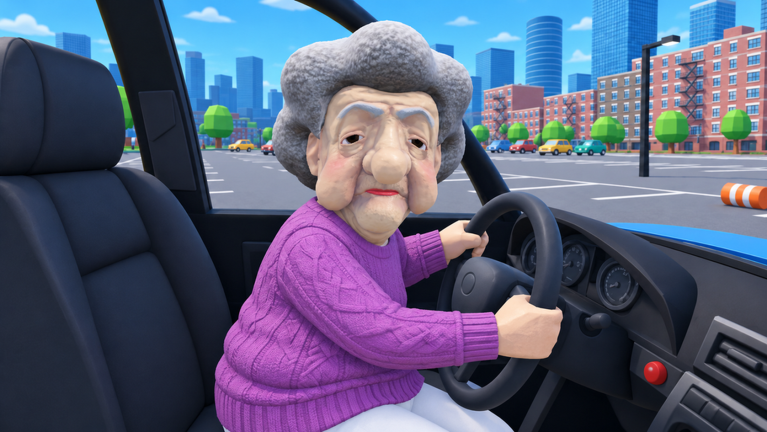
Teach Your Sister How To Drive! is a driving simulation built around a simple but unforgiving idea: you are the one steering a full lesson, and the course decides how much of it goes smoothly. The single most talked about obstacle across community clips is the S-shaped course, the twisting section that forces a car to change direction twice in a short stretch. Players who treat the whole map as one flat run get punished at that bend, while players who split the drive into planned segments get through it cleanly.
This guide breaks down the strongest route options for the S-shaped course, explains which driving situation each route suits, and pulls real examples from how the game is being played and shared right now. If you have watched a funny failed attempt on TikTok or a full tips and tricks walkthrough on YouTube, you already know the difference a chosen line makes.
Compare the Strong Route Options
There are two clearly different ways players approach the S-shaped course, and both appear constantly in posted gameplay.
Option 1: The Steady Arc Route
The steady arc route treats the S-bend as one continuous flowing motion. The driver commits to an early turn-in, holds a consistent angle through the first curve, and lets the car settle before the second curve asks for the opposite direction. This is the route shown in dedicated S-shaped course navigation clips, where the focus is on smooth inputs rather than speed. It rewards patience and is the safer pick when you are mid lesson and cannot afford a reset.
Option 2: The Two-Stage Stop Route
The two-stage stop route breaks the bend in half. The driver takes the first curve, pauses the car briefly to realign, then attacks the second curve as its own short maneuver. This is the line used in full gameplay commentary videos where the instructor is talking the whole way through and reacting to unexpected turns. It is slower, but it gives you a checkpoint inside the obstacle itself.
Neither route is universally better. The steady arc is the right choice when the car already carries light, controlled momentum from the approach. The two-stage stop is the right choice when you are still learning the car's turning feel or when a previous mistake has left you badly positioned before the bend begins.
When Each Route Works Best
- Steady arc route: best for clean approaches where the car enters the S-shaped course already centered and at moderate speed. Use it when you are chasing a smooth, uninterrupted lesson run.
- Two-stage stop route: best for recovery. If you arrive at the S-bend off-angle or carrying too much speed, stop, realign, and treat each curve separately instead of forcing one continuous line.
- Full reset before the bend: worth considering only when both halves of the S have already been botched. Restarting the approach is cheaper than fighting a car that is pointing at the wrong wall halfway through.
The key mechanic here is positioning at entry. Because the S-shaped course asks for two opposing direction changes in a short space, the car's angle in the last moment before the first curve matters more than raw throttle. Community clips consistently highlight this: the funny failures come from arriving badly, and the clean passes come from arriving square.
Game-Specific Examples From Current Play
Short S-shaped course navigation clips posted as recently as early November 2026 show players deliberately slowing down at the entry of the bend, which is the two-stage approach in action. Longer guide style walkthroughs take the opposite approach, chaining the whole lesson with steady inputs and treating the bend as one motion, which is the arc route. Funny gameplay clips where a driving lesson takes unexpected turns almost always stem from entering the S-bend with no plan at all, then overcorrecting and fighting the car through the second curve.
Practical example: run the arc route on your first two attempts to learn the bend's rhythm, then switch to the two-stage stop on any attempt where your entry is off. This pairing covers both the ideal line and the recovery line, so a single bad approach never has to end the lesson.
Applying the Routes Across a Full Lesson
Treat the S-shaped course as the pivot point of the whole driving simulation. Everything before it is setup: keep the car centered so your entry angle is clean. Everything after it is reward: a clean exit carries you forward without corrections. This is why experienced players talk about the bend in terms of entry preparation rather than mid-course heroics.
For returning players, the fastest improvement is auditing your entry. For new players, start with the two-stage stop so you always get a second chance inside the bend, then graduate to the steady arc once the car's turn response feels predictable.
Frequently Asked Questions
Q: What is the S-shaped course in Teach Your Sister How To Drive!?
It is the twisting section of the driving simulation that asks for two opposing direction changes in a short space. It is the obstacle players focus on most in shared clips and guides, and it is where route choice matters most.
Q: Which route should I use first, the steady arc or the two-stage stop?
Start with the two-stage stop. Breaking the S-bend into two separate curves gives you a realign point inside the obstacle, which is forgiving while you are still learning how the car responds. Move to the steady arc once your entry angle is consistently clean.
Q: Can a bad entry into the S-shaped course be recovered mid-bend?
Sometimes, but it is expensive. If you arrive off-angle, the two-stage stop route is your recovery tool. If both curves are already lost, restarting the approach is usually cleaner than fighting the car through the second curve.
Conclusion
The S-shaped course is where Teach Your Sister How To Drive! separates planned driving from improvised driving. Pick your line before the bend, not during it: hold a steady arc when your entry is clean, and drop into a two-stage stop whenever it is not. Do that consistently and every lesson run after the bend becomes the easy part.
Active Teach Your Sister How To Drive! Codes (November 2026)
No verified active codes are available right now for Teach Your Sister How To Drive!.