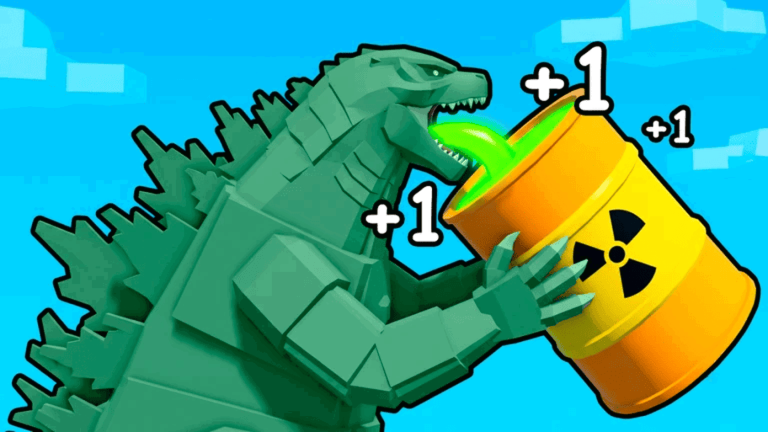
Train Kaiju to Destroy from Be Better Studio has built a loyal following since launching in early 2026. You control a growing Kaiju, train its stats, and smash cities for coins. This review compares it to the crowd of Roblox progression simulators and asks whether the long road to Hollow Earth is worth the journey.
Genre and Main Competitors
Train Kaiju to Destroy belongs to the evolution and destruction subgenre of incremental simulators. You train arms, body, and legs at separate stations, then take your monster into a city to tear down buildings. The closest competitors are Get Fat to Splash, Gym Showdown Simulator, and Become the Biggest Brainrot. All of them share the same loop of repeated actions, currency multipliers, and visual growth. Train Kaiju to Destroy sets itself apart with a fully destructible urban playground and a two-world structure.
Where It Excels vs. Alternatives
The core training loop is more satisfying than most rivals. Instead of clicking a single button, you walk between physical stations that visibly upgrade as you grow. The destruction is the star. Buildings collapse, vehicles scatter, and the screen fills with debris. Here are the features that give it an edge:
- Hands-on training stations for arms, body, and legs
- A destructible city with real time physics feedback
- Evolution-specific attacks such as tail whips, laser breaths, slams, and tornadoes
- A pet system with crafting for long-term multipliers
These systems keep you active. Gym Showdown Simulator, by comparison, leans on auto-tappers and menu-based upgrades, which can feel passive. Become the Biggest Brainrot adds humor but less environmental interaction.
Where It Falls Short
The grind is the main pain point. Early progression is fast, but the gap between milestones grows sharply. Unlocking Hollow Earth, the game's World 2, requires 50 million coins. For a player without strong pets or many hours, that is a multi-day or multi-week journey. The game also lacks structured content. There is no story, no quest hub, and no dungeon system. You train, destroy, evolve, and repeat. That repetition will drive away players who want variety. Update quality is consistent but modest. Be Better Studio regularly drops codes for free coins and potions, but there are no major named content updates on the game page. Rivals like Get Fat to Splash often add new worlds and events, which makes Train Kaiju feel static in comparison.
Progression and Monetization Fairness
Progression is linear but visible. Every coin you earn goes into training, evolution, or pets, and each upgrade shows on your monster. The pet system can significantly speed you up, but it is available through normal play, not a paywall. The only real pressure comes from the Hollow Earth coin gate. That can tempt some players to buy boosts, but the game does not aggressively push transactions. For a free-to-play Roblox title, the monetization is fair. Regular code drops further soften the grind, even though they are not a permanent content fix.
Unique Selling Points
The active destruction feedback loop is the most distinctive feature. Many simulators turn progress into numbers, but Train Kaiju to Destroy lets you see a city level every time you evolve. The training stations that scale in size and complexity are another memorable touch. The two-world structure gives dedicated players a clear, hard goal. And the evolution-based skills keep the endgame from feeling like a pure stat check.
Who Should Switch From Other Games
If you are playing Get Fat to Splash and want a game where your size actually changes a physical environment, Train Kaiju to Destroy is the stronger fit. If you enjoy the monster evolution angle in Become the Biggest Brainrot but want less meme humor and more control, the Kaiju theme here is more straightforward. If you find Gym Showdown Simulator too passive or menu-heavy, Train Kaiju to Destroy offers a kinetic alternative that still respects your time with code rewards.
FAQ
Q: How do I unlock Hollow Earth in Train Kaiju to Destroy?
A: You need to save up 50 million coins. The prompt to enter Hollow Earth appears once you have earned the required amount, and the world offers a new environment with stronger buildings and better rewards.
Q: Are evolution points important in Train Kaiju to Destroy?
A: Yes. Evolution points, also called E points, are earned through destruction and training. They unlock special attacks like tail whips, laser breaths, slams, and tornadoes, which change how your Kaiju plays at each evolution.
Q: How do I redeem codes in Train Kaiju to Destroy?
A: Launch the game, select the Shop option from the left side of the screen, scroll down to the Codes section, enter a working code, and click Submit. Developers release new codes during updates and milestones, so bookmarking a reliable code page helps you stay ahead.
Verdict
Train Kaiju to Destroy is a solid evolution simulator that stands out in a crowded genre thanks to its tactile destruction and visual progression. It beats many competitors on active gameplay, but it stumbles on long-term content variety. The Hollow Earth grind will either hook you or burn you out. If you enjoy hands-on monster progression and can handle the repetition, this is worth your time. If you need quests and events to stay engaged, you may want to wait for larger updates. As it stands, the game earns a recommendation with the caveat that patience is required for the endgame.
Active Train Kaiju to Destroy Codes (September 2026)
1 verified code available for Train Kaiju to Destroy; 5 unverified codes are being tracked.