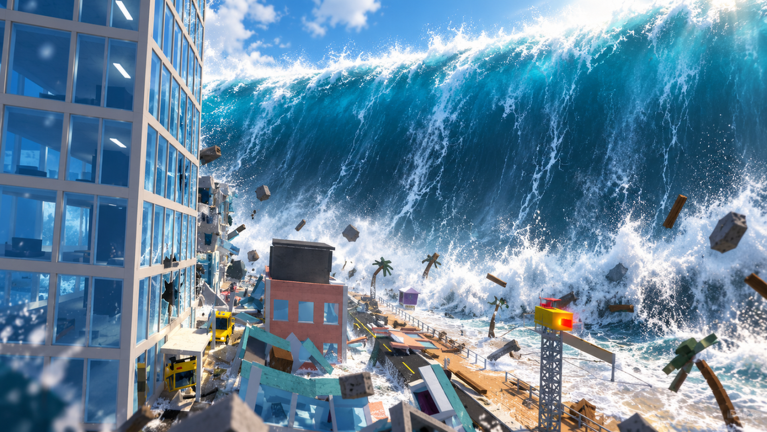
What If Disasters rewards players who read the round instead of reacting to it. Every round gives you a planning window before the event begins, and how you spend those few seconds decides almost everything that follows. This guide breaks down the hidden mechanics behind the disaster type announcement, the structure choices that quietly keep you alive, and the small positioning habits that separate short runs from long ones.
The Disaster Type Announcement Is Your Real Timer
The most overlooked system in What If Disasters is the announcement itself. The game offers plenty of time to plan a survival strategy before the disaster arrives, so hesitation after the reveal is pure waste. Each disaster demands a different response, and waiting even a few seconds to decide where to stand can be fatal once the event fires.
Smart players treat the pre-round phase as scouting time, not idle time. Scan for buildings with roofs and walls, mark high ground for flood or tsunami rounds, and pick a sturdy structure with a wide base before the announcement even lands. When the disaster type finally appears, you are simply executing the plan you already built.
Hidden Positioning Interactions Most Players Miss
Earthquakes reward open ground, not cover
Structures are the danger during an earthquake, so the correct play is to move away from all buildings and reach open ground. This inverts the instinct most survival players build in other rounds, where shelter is everything. Recognizing that swap quickly is a hidden mechanic in itself.
Volcano eruptions and meteor showers punish hiding
For eruption and meteor rounds, prioritize visibility and mobility over concealment. Players who duck indoors lose sight of incoming debris and get trapped by falling geometry. Stay outside where you can see the sky and keep moving.
Blizzards and acid rain flip the rule back
If the announcement calls a blizzard or acid rain, immediately take cover under solid roofing. The alternating ruleset is why a single fixed strategy fails so often: the same rooftop that saves you in acid rain gets you flattened in an earthquake.
Floods and tsunamis depend on map edges
High ground matters when water rises, and standing too close to the map edge, especially near the ocean, leaves you with nowhere to retreat. Identify elevated terrain during the planning window so the flood round becomes a short climb instead of a panic sprint.
Why These Hidden Systems Matter
What If Disasters is built on unpredictable event rotation. The players who adapt round to round survive longer than the players who memorize one safe corner of the map. Structure density is another quiet factor: joining a large crowd on one building can cause it to collapse under the combined load, so a less popular but wider structure is often the smarter pick. Positioning near a ledge is a small edge too, because it lets you jump down instantly when the round turns against you.
How To Use The Planning Window Every Round
- During the countdown, look for shelter candidates with both roofs and walls, and note a separate high ground route for water events.
- Choose a sturdy building with a wide base and avoid stacking onto a structure that already holds a large group.
- Stand near a ledge or drop point so you can leave fast if the announcement is an earthquake.
- Watch veteran players in the opening seconds. Experienced survivors head straight to strong spots once the disaster is announced, and mirroring their path is a reliable shortcut.
- Act the instant the disaster type is revealed. Speed of response is a mechanic as real as the terrain itself.
Common Mistakes That End Runs Early
- Running one strategy every round. Disasters are unpredictable, and adaptability beats repetition.
- Hiding indoors during eruptions or meteor showers. It removes your visibility when you need it most.
- Crowding a single structure. Too many players on one building risks a collapse that takes everyone down.
- Ignoring map edges near the ocean. Flood and tsunami rounds strand you against the boundary.
- Standing idle during the planning phase. The game gives you time to plan; not using it is the easiest way to lose a run.
Frequently Asked Questions
Q: Does What If Disasters give you time to plan before the disaster starts?
Yes. The game provides a planning window before the event arrives, which is meant for scouting shelter, high ground, and sturdy structures so you can move the instant the disaster type is announced.
Q: Should I hide indoors during every What If Disasters round?
No. Indoor cover works for blizzards and acid rain, but open ground is safer during an earthquake, and visibility plus mobility is the priority for volcano eruptions and meteor showers.
Q: Why does my building fall in What If Disasters even though I picked a good spot?
Crowding is usually the cause. Large groups gathered on the same structure can bring it down, so choose a sturdy wide-based building away from the biggest cluster and stay near a ledge for a quick escape.
Conclusion
Hidden mechanics in What If Disasters all point to the same habit: plan early, read the announcement, and change your answer for each event. Use the countdown to scout shelter, high ground, and wide structures, watch where veterans run, and never let a single strategy carry you through the whole session. Do that, and your runs get noticeably longer this October 2026.
Active What If Disasters Codes (October 2026)
No verified active codes are available right now for What If Disasters.