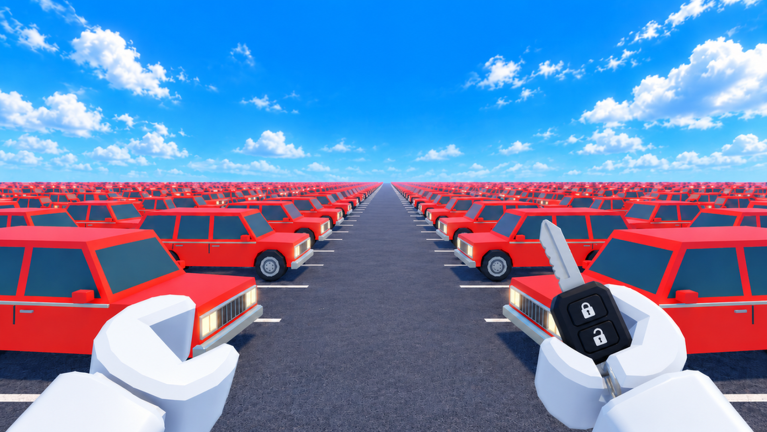
Where Did I Park?, the Caboose Studios parking search game on Roblox, is built on a deceptively simple idea: your correct car is hidden among 100,000 lookalikes, and you check them one row at a time until the right one is found. What separates a fast session from a slow one is not luck, it is whether you are playing solo or with a squad, and how you split the work. This guide covers the advanced angle most players ignore: optimizing the game around its shared checkout rule.
Why Solo and Squad Play Are Fundamentally Different
Every car your team checks is ruled out for everyone. That single rule changes the math of the entire lot. In solo play, each tap costs only your time, so sweeping wide and fast wins. In a squad of up to four players, tapping the same row as a teammate is pure waste, because that check already covered them too.
Group play also multiplies your economy. Gems from working codes and in-run earnings fund your four core upgrades: Search Speed, a wider Radius, Walk Speed, and Drones. With more players checking cars and collecting cash and valuables between rows, a squad builds upgrade income faster than any solo runner.
Best Strategy When You Play Alone
Solo players must treat every second as their own overhead. Prioritize in this order:
- Push Search Speed and Radius together first. They multiply each other: faster checks over wider coverage means more cars eliminated per minute.
- Add Walk Speed once you notice you are spending more time crossing the lot than checking cars.
- Invest long term Gem income into Drones, since they keep covering spots while you move to the next block.
On the lot itself, sweep in straight lines and never double back over a row you already cleared. Cash and valuables you pick up between cars should feed straight into the next upgrade tier rather than being banked early.
Between search runs, solo players should hit the junkyard and price check every spawn. Buy the most expensive car you can afford, then drive it to pit stop repair: park on the lift, press the green button, open the bonnet and finish the engine work. Next, take it to pit wheels, press the red button to lower the wheel machine and complete that pass. A full engine and wheel job visibly climbs the condition bar, and that condition percentage is what makes the expensive purchase pay off. Doing only half the job wastes the premium you paid.
How to Adapt When You Join a Group
Once teammates are in the lot, the solo habit of sweeping a whole section yourself becomes a liability. Call a split before the first tap. Divide the lot into vertical strips or rows, and give each player exclusive territory. The point is coverage, not speed on one row.
Communication also matters at the junkyard. If one player calls out a high priced spawn, the group should decide who buys it instead of two players burning cash on separate cars. One shared restoration, done fully through pit stop repair and pit wheels, beats two half repaired vehicles.
Role Suggestions for Team Play
- Scanner: the player with the highest Search Speed and Radius, responsible for the densest lookalike rows.
- Runner: the player who stacked Walk Speed, shuttling between rows and grabbing cash and valuables dropped between cars.
- Mechanic: the player who banks Gems into pit stop repair runs, owning engine and wheel work for the team car.
- Drone operator: the player funding Drones, keeping automated coverage on already passed blocks while the scanner pushes forward.
When to Switch Approaches
Drop back to a solo style the moment your squad thins out, because territory splits with two players stop scaling when only one is left. Conversely, if your solo sweep stalls in a huge block of identical rows, invite players in and reset the split immediately. The shared checkout rule rewards a fresh division of labor far more than it rewards one player checking faster.
Hidden Trick: Shared Checkouts Are the Real Multiplier
Upgrade efficiency lets you check cars faster, but wasted duplicate checks throw that advantage away. Veterans always pair the two sides: individual income upgrades on one side, disciplined row ownership on the other.
Q: How many players can search together in Where Did I Park?
You can search alone or team up with up to three other players, giving a maximum squad of four in the parking lot.
Q: Does checking a car for my whole team cost them anything?
No. Each car your team checks is ruled out for everyone, which is why splitting rows rather than following teammates around is the efficient group play.
Q: Which upgrades should a squad fund first in Where Did I Park?
Search Speed and Radius first, since they multiply your elimination rate, then Walk Speed for travel, and Drones for automated coverage while the team moves between rows.
Conclusion
Where Did I Park? rewards systems thinking in both modes. Solo runners win with Search Speed, Radius, and a strict junkyard to pit stop repair to pit wheels loop on the priciest car they can afford. Squads win by respecting the shared checkout rule, splitting rows, and assigning scanner, runner, mechanic, and drone roles. Know which mode you are in before your first tap, and the 100,000 lookalikes stop feeling endless.
Active Where Did I Park? Codes (November 2026)
No verified active codes yet for Where Did I Park?; 7 unverified codes are being tracked.