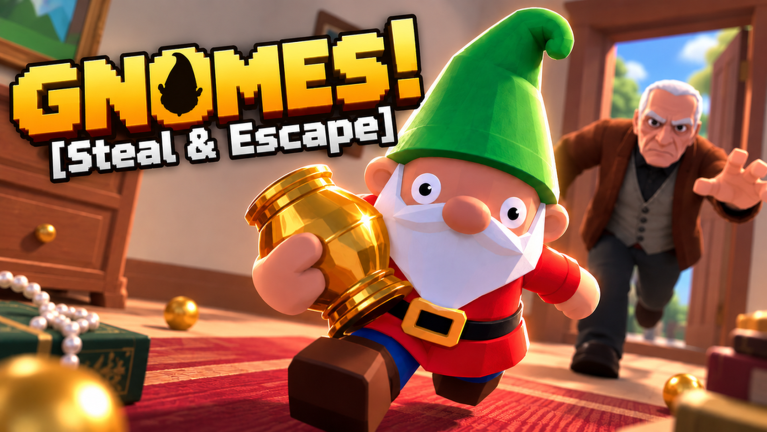
Gnomes! (Steal & Escape) puts you inside a house with one job: grab valuable items and get back out before the Homeowner catches you. The tools and upgrades you unlock give you more to work toward between trips, and quests hand out extra rewards along the way. The part most players underestimate is that a solo run and a squad run are two completely different games. The same hallway that is a slow, careful sweep for one gnome becomes a race with three bodies moving at once, and the Homeowner reacts to that noise in ways that change how you should plan every trip.
Why Solo and Squad Runs Play Differently
On a solo run you are the only target, the only noise, and the only pair of hands. You decide when you enter a room, how long you linger over a valuable, and when you break for the exit. Nothing pulls you off your line.
Once other gnomes join the job, the house stops being a private route and becomes shared space. Two gnomes reaching the same shelf means one of them is wasting time, and three gnomes in one corridor means the Homeowner has an easy path to whoever is last. The tradeoff is obvious: a squad can clear valuables far faster, but only if the group splits the work instead of stacking it. Solo play trades speed for control. Squad play trades control for volume.
Best Strategies When You Play Alone
Time every entry against the Homeowner
Solo runs are built around patience. Enter when the Homeowner is on the far side of the house, take the room that is furthest from the exit first, and work your way back toward the escape so you are always moving outward. The moment you are carrying several valuables at once, your priority flips from loot to exit. Getting caught late in a run costs you everything you already grabbed, so the smart solo habit is to leave with a smaller load more often instead of gambling on a full sweep.
Spend your tools and upgrades on control first
Tools and upgrades are unlockable progress, and on a solo run they should serve your escape rather than your greed. Anything that helps you read the Homeowner's position, move quietly, or reach an exit faster pays off every single trip. Greed-focused upgrades only matter if you are already surviving consistently. A player who never gets caught can carry more valuables per run than a player who grabs more but dies at the door.
Treat quests as your safety net
Quests give you another way to earn rewards when a risky steal does not go your way. Solo players should always have one quest running in the background so that a failed escape still leaves you with progress toward something. This keeps your session productive even on the nights the Homeowner wins every encounter.
How to Adapt When Other Gnomes Join the Job
The biggest squad mistake is four gnomes following one route. Split the house into lanes: one gnome takes the side rooms, another handles the center, and nobody doubles back through a space someone else already cleared. Call your exits early. If two gnomes are near the escape at the same time, one should break first so the corridor does not clog while the Homeowner closes in.
Squads also need a shared rule for when a run goes wrong. If the Homeowner locks onto one player, that player should pull the chase away from teammates carrying valuables rather than dragging the problem into the group's path. Solo play hides bad positioning; squad play exposes it instantly.
Role suggestions for team play
- Grabber: the gnome who loads up on valuables and does nothing else. Moves only when the path is confirmed clear.
- Distraction: the gnome who deliberately draws the Homeowner away from the Grabber, then escapes on a separate line.
- Scout: the first gnome through a new room, mapping where the Homeowner is before the Grabber commits.
- Quest runner: the player who focuses on quest objectives while the rest of the squad handles the theft, so reward progress never stalls.
Rotate these roles between runs. A player who only ever scouts never learns timing, and a player who only ever grabs never learns the map.
When to Switch Approaches
Switch from group play back to solo when your squad is repeatedly caught together in the same corridor, or when nobody is coordinating exits and the Homeowner is cleaning up the whole team in one pass. Switch to a squad when you are consistently surviving solo runs with a comfortable margin, because at that point you are leaving value on the table by not splitting the house. Also lean solo when you are working a quest that needs precise timing, and go squad when you need raw loot volume in a short session.
The honest rule is simple: play the format that matches your current survival rate. Clean escapes mean it is time to add bodies. Constant catches mean it is time to strip the run back down.
Q: Does bringing other gnomes into the house make the Homeowner harder to escape?
The Homeowner's job does not change, but your margin for error does. More gnomes means more movement through shared rooms, which makes careless grouping the real danger rather than the chase itself.
Q: Are tools and upgrades worth prioritizing if I only play solo?
Yes. Solo players get more value out of upgrades that support reading the Homeowner and reaching exits, because a single caught run wipes everything you were carrying.
Q: What should I do when a squad run keeps falling apart near the escape?
Set an exit order before you go in. Staggered departures keep the corridor clear, and one gnome should always be free to pull the Homeowner away from the players still carrying valuables.
Conclusion
Gnomes! rewards the player who knows which mode they are actually playing. Solo runs are about control, patience, and protecting what you already hold. Squad runs are about lane discipline, staggered exits, and clear roles so nobody duplicates work. Read your own survival rate honestly, pick the approach that fits it, and use quests to keep progress flowing whenever a steal goes sideways. That habit of switching formats on purpose, instead of by accident, is what separates a veteran gnome from a caught one.
Active Gnomes! Codes (October 2026)
No verified active codes yet for Gnomes!; 1 unverified code is being tracked.